29 January 2013
Tamela Trauth, 1975 - 2013, R.I.P.


05 January 2013
For My Gun Friends
That said, let me get where my recent reflection on this issue has left me. In my opinion, arrived at after reading what friends wrote, what I could find online, and driving alone for some good drives, while it makes every bit of sense to me to protect the right of individuals to own guns—handguns, rifles, and shotguns in particular—I can't find that the joy of target practice with a rapid-fire semiautomatic weapon having a high-capacity magazine makes the availability of these weapons justifiable. I do find that in other countries that have adopted policies banning or restricting access to such weapons that the policies have worked as intended: mass shootings stop [2, 3].
What I think ought to happen is that my friends in the gun community ought to entertain this idea: that their and others' access to rapid-fire weapons is the major reason we have mass shootings in this country. I think they also ought to examine the degree to which their Guns! Guns!! Guns!!! attitude is also a big part of that same problem. There is a lot more evidence of moderate Muslims taking down the points of views of radical Islamists than there is of moderate gun owners taking down the shoot-first points of views that are widespread in the USA. Bumper stickers like "Keep honking, I'm reloading" and Facebook memes like "The ammo shortage means there won't be a warning shot" are part of the problem, and my gun friends need seriously to entertain the idea that you, my gun friends, need to publicly tell those people to shut up, that they're part of the problem.
There is a substantial cadre of gun owners in this country that are just bullies. They think they can have their way at everything from whether someone cut them off in traffic to the outcome of political races, if not by whipping out a gun, then by whipping out gun imagery. The kinds of political ads during the 2010 midterm elections, with candidates targeted in sights, isn't something without impact, or those paying for the ads wouldn't put them out there. And one of the impacts is making violence against politicians more likely to happen. Whether the shooting of Congresswoman Giffords and folks at her town meeting was directly correlated with those ads doesn't matter to me: I think the implication of those ads that political violence effected with guns is okay is pretty clear.
So, likely to the consternation of my gun friends, I think the onus is on you to reflect on what you can do to make this a country where there is next to negligible likelihood that a bunch of people—citizens at a political meeting, folks at a movie, kids in the first grade—are going to get shot up. If your answer is the same as it's always been—i.e., more guns—then I'm going to take that as face value evidence that you're not reflecting on anything, you're just regurgitating the same thing you've taken as gospel for years and years. I'm sorry, my friends, but it's time for you to have an epiphany that your giving up your access to rapid firing weapons with interchangeable high-capacity magazines is not an infringement on your Second Amendment rights.
Can I help you understand that there are very few of us who are interested in taking away your Second Amendment rights to own the kinds of guns that American's have owned over most of our history? What can I do to get that across to you? What kind of evidence of good will on the part of those of us asking you to give up your access to assault weapons would convince you that no one is coming after handguns, rifles, or shotguns? If you want me to take up a public education campaign among those of us who believe that humans can create tools and by and large use tools wisely—including pistols, rifles, and shotguns—I'm happy to help. Long arms have and will be used for hunting and target practice; people will have revolvers and other pistols for target practice and self defense. Slinging hot lead from a semi-automatic is fun, but it's time to let that go the way of chewing tobacco.
How's this: I'll sign something expressing my support for your Amendment II rights if you'll sign something saying you understand that those rights don't extend to assault weapons.
By the way, this whole business about standing one's ground against tyranny is played out, so you need to give it a rest. The Tom Toles cartoon below captures that about as accurately as I've ever seen. And there's not ever going to be a zombie apocalypse. There's simply no non-military context where you need an assault weapon for safety or freedom, and your desire to access one for fun doesn't justify the kinds of mass killings we've seen too many of. That's all this proposal—ban high-capacity magazines, ban assault weapons, buy back the ones already out there—is determined to address: mass killings of people who had every right to expect that some yahoo wasn't going to shoot them up.

Labels: assault weapon, bullies, gun control, guns, high-capacity magazine
15 December 2012
A Conversation on Mental Health and Guns
History
Danny was in the hospital, but was going to be fine. The local prosecutor had found a way not to prosecute our dad, but I kind of remember there was a story in the local paper about it. Our mom moved into the guest room for an extended period; our dad went on the wagon for an extended period.
The gun manufacturers are a part of big business.
Framework
- People with mental health problems; i.e., all of us. Of course, while almost all of us have acute mental health issues at isolated points in our lives, a lot of us (and I don't know the numbers) have longer term situations related to our emotional health, ability to cope, our feelings regarding how we fit in in the world, our being able to get motivated to do anything.
- Mental health care professionals: Counsellors, shrinks, nurses, doctors, and the like.
- Advocates for people with mental health problems: This cohort is all over the place, no? Some advocates want people who can't cope institutionalized; other want people who can marginally cope, deinstitutionalized. The forces of deinstitutionalization have been more effective in determining policy at federal, state, and local levels over the past few decades than the forces of institutionalization. And there was a time when there was over-institutionalization, but there have also been plenty of people in positions of authority—statutory and regulatory authority—who have erred on the side of deinstitutionalization based on the idea that it's cheaper, not on the idea that it's either more human or more effective at treating people with emotional disease.
- Gun owners who hunt.
- Gun owners who collect but never shoot.
- Gun owners who like to hurl hot lead at high velocities from a hand-held or arm-held device.
- Gun owners who like having a gun because they think it protects them. I'm not sure of the efficacy of gun ownership at protection overall or on its impact on overall crime rates (and these ought to be something that can be measured), but I enjoy a good "granny shot a burglar" story as much as the next person.
- Gun owners who like having a gun because they think it makes their criminal activities or enterprises more effective. As with the above, not sure of the degree to which reality co-relates with their beliefs.
- Gun owners who have a gun for one of the above purposes, but get their gun stolen and see it used for some other purpose. Mack still never got that Ruger he bought that got stolen before I met him back.
- Gun manufacturers.
- Organizations that represent gun interests. Here's my take on this: The NRA once represented the interests of gun owners, primarily hunters and sport shooters, but it became the lobbying arm of gun manufacturers. Our dad was a lifetime member of the NRA, and after he died and after we sold off the factory, I had The American Rifleman delivered to my dorm address at MIT. Like I noted above, I loved "The Armed Citizen" column. Who wouldn't? But I think that, contrary to what most of its members think, the NRA uses its members, underlyingly representing the gun manufacturers. This was cemented when Charlton Heston was its president: The marketing says "we represent gun owners", but if you look at who truly benefits from the policies supported by the NRA, it's not gun owners, it's gun manufacturers. So, I don't think the NRA can be an honest participant in this discussion, as much as many of you who are members would like to think so. This is entirely parallel to people who vote Republican on values issues, even though the agenda of the Republican party is, at its heart, to represent the interests of rich people. (This is why I was looking up Izzy Stone last night, because I can remember him saying something about the NRA and how it once represented gun owners, but came to represent gun manufacturers.)
- People who don't like guns for any of a variety of reasons. I was one of these people once.
- Police who would rather not have to deal with so many damned guns.
- Politicians who try to respond to all the competing interest groups. The ones who seem to have been most effective at this recently are two recent Senators from New York, now Secretary of State Clinton and her successor, Senator Gillebrand. On the gun side, they have to represent strong rural gun-owning hunting constituencies as well as urban constituencies that are concerned about guns being used against them by criminals.
- I'm sure I've left some out.
- Clearly, this is complicated.
Biases
Moving Forward
Labels: emotional health, government, gun control, guns, mental health
04 December 2012
Letter to Congressman Mica re "Fiscal Cliff"
The Honorable John Mica
2187 Rayburn House Office Building
Washington, District of Columbia 20515
Dear Representative Mica:
I write to support President Obama’s proposals regarding avoiding the austerity measures that take effect with the start of calendar year 2013.
The President’s proposal, as originally presented to congressional leadership and relayed to Congress with details by Secretary Geithner, is consistent with the fiscal priorities the President campaigned and was re-elected on: Avoid a tax-rate increase on working people; let tax rates rise on capital gains and those making over $250,000; return the threshold for estate taxes to one-million dollars from five million; tax reform to address loopholes; protect Social Security, Medicare, and Medicaid. Those measures generate $1.6 trillion in revenue and $400 billion in savings over the next ten years. The GOP alternative—proposed cuts to safety-net programs—have nowhere near that kind of deficit reduction impact; it again places the burden on people who work, who have gotten the short end of the stick over the last several decades.
You and your GOP colleagues have the opportunity to do what the American people have said through the ballot box that they want: work with the President to achieve a responsible national agenda. No more games with the debt ceiling; no more sequestration instead of responsibility; no more party of no. And you personally have the opportunity to show again your leadership within your party by getting on the right side of the American public and of history.
Sincerely,
Timothy A. Wilson
02 December 2012
Presidential Biographies: Washington through Buchanan
| No. | Start | End | President | Born | Died | Biography |
|---|---|---|---|---|---|---|
| 1 | 30 APR 1789 | 4 MAR 1797 | George Washington | 22 FEB 1732 | 14 DEC 1799 | Flexner, John
Thomas, Washington:
The Indispensable Man , Back Bay Books, 1994 , Back Bay Books, 1994
|
| 2 | 4 MAR 1797 | 4 MAR 1801 | John Adams | 30 OCT 1735 | 4 JUL 1826 | McCullough,
David, John
Adams , Simon and Shuster, 2001 , Simon and Shuster, 2001
|
| 3 | 4 MAR 1801 | 4 MAR 1809 | Thomas Jefferson | 14 APR 1743 | 4 JUL 1826 | Ellis, Joseph
J., American
Sphinx: The Character of Thomas
Jefferson , Vintage, 1998 , Vintage, 1998
|
| 4 | 4 MAR 1809 | 4 MAR 1817 | James Madison | 16 MAR 1751 | 28 JUN 1836 | Ketcham,
Ralph, James
Madison: A
Biography , University of Virginia
Press, 1990 , University of Virginia
Press, 1990
|
| 5 | 4 MAR 1817 | 4 MAR 1825 | James Monroe | 28 APR 1758 | 4 JUL 1831 | Ammon,
Harry, James
Monroe: The Quest for National Identity (Signature
Series) , American Political
Biography Press, 1998 , American Political
Biography Press, 1998
|
| 6 | 4 MAR 1825 | 4 MAR 1829 | John Quincy Adams | 11 JUL 1767 | 23 FEB 1848 | Nagel,
Paul, John
Quincy Adams: A Public Life, a Private
Life , Harvard University Press,
1999 , Harvard University Press,
1999
|
| 7 | 4 MAR 1829 | 4 MAR 1837 | Andrew Jackson | 15 MAR 1767 | 8 JUN 1845 | Brands,
H. W., Andrew
Jackson: His Life and
Times , Anchor, 2006 , Anchor, 2006
|
| 8 | 4 MAR 1837 | 4 MAR 1841 | Martin Van Buren | 4 DEC 1782 | 24 JUL 1862 | Niven,
John, Martin
Van Buren : The Romantic Age of American Politics (Signature
Series) , American Political
Biography Press, 2000 , American Political
Biography Press, 2000
|
| 9 | 4 MAR 1841 | 4 APR 1841 | William Henry Harrison | 9 FEB 1773 | 4 APR 1841 | Cleaves,
Freeman, Old
Tippecanoe: William Henry Harrison and His
Time , American Politcal
Biography Press, 1990 , American Politcal
Biography Press, 1990
|
| 10 | 4 APR 1841 | 4 MAR 1845 | John Tyler | 29 MAR 1790 | 18 JAN 1862 | Chitwood, Oliver
P., John
Tyler: Champion of the Old
South , American Politcal
Biography Press, 1990 , American Politcal
Biography Press, 1990
|
| 11 | 4 MAR 1845 | 4 MAR 1849 | James K. Polk | 2 NOV 1795 | 15 JUN 1849 | Borneman, Walter
R., Polk:
The Man Who Transformed the Presidency and
America , Random House, 2008. , Random House, 2008.
|
| 12 | 4 MAR 1849 | 9 JUL 1850 | Zachary Taylor | 24 NOV 1784 | 9 JUL 1850 | Bauer,
K. Jack, Zachary
Taylor : Soldier, Planter, Statesman of the Old
Southwest , Louisiana State University
Press, 1993 , Louisiana State University
Press, 1993
|
| 13 | 9 JUL 1850 | 4 MAR 1853 | Millard Fillmore | 7 JAN 1800 | 8 MAR 1874 | Rayback, Robert
J., Millard
Fillmore: Biography of a
President , American Political
Biography Press, 1992 , American Political
Biography Press, 1992
|
| 14 | 4 MAR 1853 | 4 MAR 1857 | Franklin Pierce | 23 NOV 1804 | 8 OCT 1869 | Wallner, Peter
A., Franklin
Pierce: New Hampshire's Favorite
Son , Plaidswede Publishing, 2004 , Plaidswede Publishing, 2004Wallner, Peter A., Franklin Pierce: Martyr for the Union  , Plaidswede Publishing, 2007 , Plaidswede Publishing, 2007
|
| 15 | 4 MAR 1857 | 4 MAR 1861 | James Buchanan | 23 APR 1791 | 1 JUN 1868 | Klein, Philip
S., President
James Buchanan: A
Biography , American Political
Biography Press, 1995 , American Political
Biography Press, 1995
|
More to come as I take time to update. I'm currently rereading the first volume of Edmund Morris's three-volume set on Theodore Roosevelt.
Labels: adams, bio, biographies, biogrpahy, buchanan, fillmore, j. q. adams, jackson, jefferson, madison, monroe, pierce, polk, president, presidential, taylor, tyler, van buren, washington, william henry harrison
04 November 2012
Performance Review: The Who
Quadrophenia Tour
Amway Center, Orlando, Florida
Saturday, 3 November 2012
Mack and I went to see The Who last night at the still newish Amway Center in Orlando.
Background: The Who are one of the few bands that have mattered to me for a long time. Tommy was one of the first LPs I ever bought (at some little record store in Lakeland, Florida, to try to play through this RCA reel-to-reel tape deck (standard two-channel quarter-track quarter-inch dealie) I had conned my dad into buying me (at some home furnishings store in Leesburg, Florida, earlier that same winter of 1971 (I think))). (The ghost of Lowell George celebrates my having closed all parentheses properly.) (Yes, I was a doofus about electronics at the time: The r2r wanted line levels in, but my turntable had a magnetic cartridge, so the level was a factor of 100 or more too low.) Spent that late winter of 1971, a freshman in high school, listening to Tommy and Jesus Christ Superstar over and over and over again on the headphone output of that tape deck. (Dammit! Not supposed to reference things at the outer level introduced at an inner level. Bad scoping.)
Who's Next came a year or so later, leading to a world where you could hear ``Won't Get Fooled Again'' on the same daily basis as ``Stairway to Heaven''. When I was a senior in high school, Quadrophenia was released, and I spent many hours both listening to it—by then I had gotten a receiver with a real phono preamplifier, and I could blast it on the stereo—and playing tunes from it on the piano. I still have the well-worn songbook.
As with much of a young man's fancy, taste changed, and my intense interest in The Who waned but never vanished. Many phases followed: Yes and ELP, Todd Rundgren (say it like Beavis), King Crimson (had had a Record Club of America pressing of In the Court of the Crimson King from some time in high school, but that interest didn't really take off until I got a copy of Larks' Tongues in Aspic), followed after dropping out of college with a turn into punk and new wave. Over the years I never really became aware of many opportunities to see The Who, and after the disappointments of live arena performances by Yes and Jethro Tull, I just didn't crave humongous rock shows like I might have just a few years earlier.
Still, when I back in college in Boston and visiting a friend in Queens for the weekend one summer, I was very disappointed when he said, ``You wouldn't have wanted to go see The Who at Giants' Stadium, would you? A friend needed to sell his tickets, but I didn't think you'd want to go.'' (So disappointed. Yes, we had seen Minutemen and Black Flag and the Hüskers in club scenes—and numerable Zappa shows at disparate locales—but that didn't mean I wouldn't want to go see The Who. Really, dude, what were you thinking? The Who? Not go see The Who?)
I came to realize that of all the big name acts, The Who was the one that I wanted to see. (If you ask me ``Beatles or Stones?'' I always answer, ``The Who''.)
So, when another friend posted on Facebook a few months ago about buying tix to take his kids to see The Who perform Quadrophenia in Nashville, I was like, ``The Who are on tour? Can I still get tickets?'' And, yes, I could still get tickets, which is how we ended up at the show last night.
I enjoyed it tremendously. The backing musicians were great, including two horn players and three keyboardists. Pino Palladino admirably covered the bass parts, and Simon Townsend, Pete's brother, played guitar and sang. Zak Starkey, Ringo's son, was just great on drums, copping the Moon feel and groove. Roger Daltrey has likely seen better days as a singer, but the crowd covers for him when he can't hit the high notes anymore. (He may never be able to hit those high notes again, but we hear them whether he hits them or not.) His and Pete Townsend's stage presences are both solid professionals, old guys who've done this a zillion times. Does it lack a certain spontaneity? Sure. Are they consumate showmen, Roger whirling the mike around (no wireless anywhere, as far as I could tell), Pete still doing the windmill and crunching out thick waves of sound on any one of a dozen guitars? Absolutely.
Here's some photos I shot with my iPhone and posted in this set on Flickr.
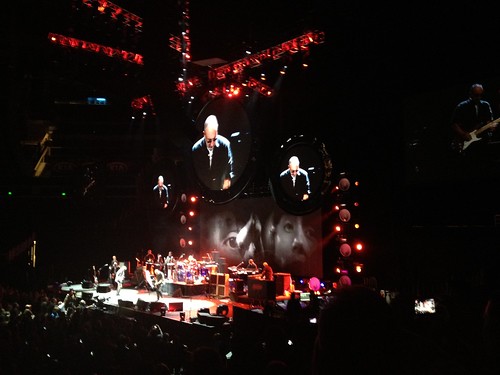
Pete, during ``The Real Me'' (I think).
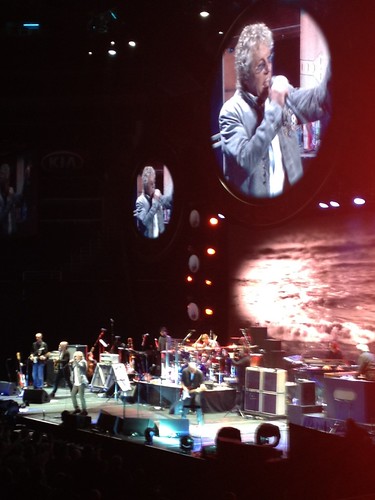
Roger, during ``The Real Me'' (I think).
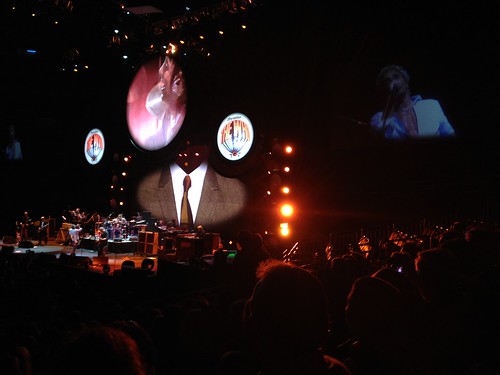
Keith Moon (!) posthumously singing ``Bell Boy'' by the magic of video.
Not only did Moon sing, there was also a bass-drums duet, with prerecorded posthumous bass performance by John ``Ox'' Entwistle and the resourceful and wonderful aforementioned Zak Starkey.
For an idea of how guys who've been playing together for a long time, have worn themselves out many times over, sound today, here's a video of the band, with Roger and Pete trading lyrics on ``Helpless Dancer''. Okay, ``sound today'' is probably generous, because of the audio quality.

``Won't Get Fooled Again''.
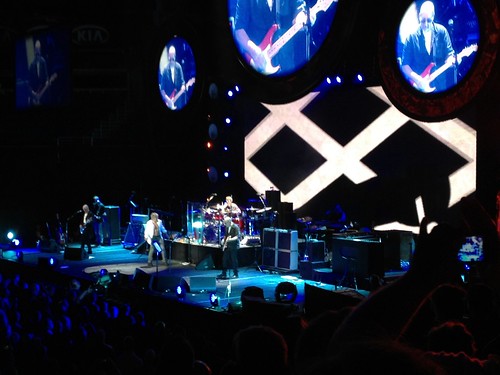
More ``Won't Get Fooled Again''.
19 October 2012
My Scouting Experience
More people need to understand how for generations institutions like the Boy Scouts, the Roman Catholic Church, prep schools, and sports programs have protected men in their organizations who prey on boys. Leadership in those institutions has not only protected the abusers, it also has worked to ensure that there are roadblocks that prevent out-of-the-closet gay men from advancing within those groups.Here's my personal reasons for having strong feelings about this.The abusers are overwhelmingly not gay men: Outside the ostensibly celibate priests, most of them are in traditional heterosexual marriages, and they are not at the same time seeking emotional or sexual relations with a same-sex someone else of legal age. They are using positions of power to fulfill their own effed-up wants, leaving behind boys who became men unfairly burdened with overcoming emotional scars they shouldn't have. There's no evidence that gay men who are out of the closet have the same history of preying on boys and teens as these ostensibly normal creeps do.
It's understandable that the victims of these abuses would focus on the perpetrators, but we collectively need to step back and see that at a cultural and political level, the institutional stances of organizations like the Roman Catholic Church and the Boy Scouts are intimately tied to cultures of abuse of boys by men using the power that comes with their roles in those organizations. We need to rein in the power of those institutions: Instead of letting them set the tone for moral discussions, we need to send them to the cultural dog house for a generation or two until they can demonstrate that they've changed their ways.
I was briefly in the Boy Scouts back in my hometown of Centerville, Tennessee, during fall of 1967. I was in the 6th grade at the time. I had previously been, off and on, a Cub Scout, largely because our mom was, off and on, a Den Mother. I don't recall the pack number or the troop number, but this was the Boy Scout troop that met in the basement of the Methodist Church on Monday nights.
Let's be realistic: I wasn't the most butch sixth grader in the world. I was what I think is pretty typical for one category of proto gay men at that age: Minimal interest or success in sports, played the piano, sang in the church choir, liked to read books, liked being in the kitchen, liked to play games, liked movies and TV shows. I was in 4-H for photography and electrical stuff, and I didn't object to playing outside with friends -- almost all boys -- making up sci-fi scenarios that usually ended in imagined death, dismemberment, and planetary annihilation, but we didn't play touch football or baseball. Most of our little gang were well on the path to being band fags (of the true homo variety), and I was a pretty soft compared to the ideal boy on his path to manhood.
But I wanted to do Boy Scouts because friends from school were doing Boy Scouts. And our dad had gotten himself into some kind of role as lead for fundraising for, I think, the entire Middle Tennessee Council. So I went to the Monday night meetings, learned to tie some knots, read the Scouting Handbook for the juicy parts about wet dreams and masturbation, etc.
Some time that fall, there was a Camporee held over at a park in Waynesboro. Not sure of the regional extent of troops invited, but it was a big gathering. For those of you who might remember, this was the Camporee where David Patton got bit by a black widow spider and had to be taken to the emergency room. Also, people went swimming downward of the Waynesboro sewer treatment plant and discovered leeches in the water. It was already too cold to be swimming if I recall, but I was tempted until I heard about the leeches. The spider thing didn't bother me.
The Camporee was two nights, I think: Friday and Saturday. (The internal timing of that weekend is a unclear to some extent, but I remember getting home on Sunday morning and being exhausted.) It was already getting dark when we got there on Friday, so I think that night we just ate some kind of supper -- hot dogs? beanie weenies? -- and crashed after setting up camp. I remember digging a trench around the tent I shared with Rusty Bates, and I think it rained that night.
Saturday was Scout stuff: The thing I remember is some reconnoitering and estimating the height of a telephone pole. I wish I had better memories of the rest of that day.
That night, the older boys in our troop took the younger boys on a so-called snipe hunt. Yeah yeah, standard hazing. They took us out onto a woody hill on the side of Hurricane Creek, gave us a bag, told us to wait for snipe, left us, etc. No flashlight, no nothing. Each of us solo from the rest.
Okay, maybe the more butch thing to have done would've been to stumble down the hill in the darkness, but what the hell did I know. I was alone, at night, on a hill, in the dark, with a bag. I wasn't going nowhere. I knew the snipe part was bullshit, but the message had been to be quiet or else.
I'm not sure how long I waited. I remember Bill McDonald finally coming and retrieving me. Everyone thought it was a good laugh, and it didn't bother me. I could've stayed out there all night.
But it was clear to me that this was not something that was to be reported to anyone else. It wasn't made explicit, but the vibe was that this stays within the troop.
Later that night, just like the night before, the bigger boys and the Scoutmaster stayed up. I wanna say there was an open-sided tent with several Coleman lanterns shining. I had never seen Coleman lanterns before, and they were so bright. I came to understand somehow that the Scoutmaster had Playboys for the bigger boys to look at. There was a lot of laughing and fun coming from the area around the Scoutmaster's tent. Was there beer, too? I don't know.
Like I said, we got back Sunday morning, and I was exhausted. I slept the rest of that day. The following day was the troop meeting, and I didn't want to go. It was one of the few times I can remember butting heads with my father. He was embarrassed that his son didn't want to go to Scouts when he was raising money for them. I knew I wasn't supposed to tell of the snipe hunt or of the boys staying up with the Scoutmaster looking at dirty magazines. I just said I wanted to say home and watch "Laugh In" instead, but what I really wanted was just not to go to Scouts. I thought the whole operation was bogus, and I didn't like how I was treated, but I couldn't articulate that.
Years later, if I recall correctly, said Scoutmaster was arrested, tried, and sentenced for exactly the kind of behavior one might think a grown man sharing horndog material with teenage boys might be geared to lead to. I am not sure if this recollection is accurate, and I don't see any value in trying to name names.
A few years after that, the Centerville Church of Christ stood up its own Boy Scout troop. I hope and presume that troop didn't have the kinds of issues I recall. I never heard of such.
No big summary here, but I've had my doubts about the Scouts ever since that Camporee. It's not hard to imagine that others similarly disposed but better geared towards organizational leadership as that Scoutmaster could rise to power within the organization and lead the organization toward protecting the abusers. Given what I know of the sexual peccadilloes of Scouting's founder (regardless of how he was portrayed by Fred McMurray), maybe it had been that way forever.
Scouting needs to quit blaming gay men for its troubles. It needs to stop throwing out gay scouts. It needs to be completely open about how it's been protecting sexual predators, possibly forever, instead of fighting court cases about such. Otherwise, it has no credibility with this one.
