21 January 2010
Mass Reax: Quit Freaking Out!
Are people still shouting?
Is there writhing? Rending of garments and gnashing of teeth?
Have the Biblical proportions of Tuesday's DEM loss of one of the Massachusetts seats in the US Senate been sufficiently articulated?
Who am I kidding? I think the drama is completely out of proportion. It's a loss to "our" side, no doubt, but it's not the end of the world, of health-care reform, of climate-change legislation, etc. It means that we need new paths towards the goals we cherish, but it doesn't change the goals. If they were desirable and reachable previously, they are still desirable and reachable today. It just requires more effort. It may impact how quickly they are achieved. I know it's difficult to see things from perspectives of longer than five-minutes ago, but we didn't get into this mess overnight, and we won't get out overnight, either, so get used to the idea that we're not getting to the Promised Land tomorrow night. Or the night after that, either.
Those of use who share the ideals of better access to health care, reduced health care aggregate costs, reduction in greenhouse-gas emissions, broader concepts of human rights more inclusive of lesbians, gays, bisexual, and transgender people (without diminishing any individual's right to worship as they choose, by the way), a fairer tax system in which the middle class don't subsidize the rich and in which the poor are given a better chance to share in the bounty of modern life, etc., have to quit freaking out over the loss of one Senate seat in a special election.
We need to quit referring to it as Ted Kennedy's seat: It was never his seat. It was one of two seats that the Commonwealth of Massachusetts is allotted under the Connecticut compromise that secured support for the 1787 Constitution of the US. At that time, it was a seat that belonged, in many ways, to the government of the Commonwealth, but with the passage of the 17th Amendment, it now belongs to the people of Massachusetts.
If the powers that be, largely the Democratic Party of Massachusetts, hadn't have been so freaked out with the fantasy that John Kerry might actually become President of the United States in 2004, and that Mitt Romney might appoint a Republican to the seat, they wouldn't have messed with the long-standing procedure in Massachusetts of having the governor appoint someone to serve in an open Senate seat for the remainder of the term. If the powers that be, again the Democratic Party of Massachusetts in conjunction with my national Democratic Party hadn't freaked out that they would be one short of the 60-vote supermajority now seemingly required for even the most mundane legislative passage hadn't gotten the law changed to allow a governor's appointment until a special election could be held (instead of leaving the seat open during that time), enough factors would be different that a different outcome than Tuesday night's election would've been likely.
I feel that for my party and the Massachusetts party to do this was so full of hubris and arrogance that it almost certainly set the stage for the kind of pissed-off results of Tuesday night. I lived in Massachusetts long enough to know the hubris and arrogance of the local Democratic leadership, and in this case they were aided and abetted by the leadership of the party in Washington, including the President. And I admit I see this with hindsight and shame.
So, as a matter of principle, rules shouldn't be changed in the middle of the game unless they're discovered to be obviously unfair to all participants.
And, as a principle of life on this rock, in this Universe, all actions come with unintended consequences, many of which that come back to bite you in the ass.
Now, the other side has issues with principles and practices, too. They need to stop lying, starting with the lie that the situation with the national debt is due to the current administration, when almost to a one those making those statements said nothing during the previous administration, an administration of year after year of deficit spending, due in some part to military engagement, but due in large part to a tax system that raised inadequate revenue since it taxed those with the highest earnings at historically low and insufficient rates. The first reason we have all this debt is because of the Bush tax cuts. The second reason is the 2009 stimulus bill and changes in monetary policies that were necessitated by the incredible credit crunch that led to the economic downturn in 2008. The financial regulatory posture leading to that has roots in both parties, but the worst consequences, including the real-estate bubble, happened under the previous administration. Stop lying like none of this ever happened.
You know, lying is just plain wrong. Stop lying.
I sometimes think that my conservative, tea-party-esque, friends are just plain and simply anarchists, hoping for a complete economic collapse followed by a lack of civil order that would allow those with the most guns to take over. I have a simple message for them: Get your head out of your asses, it ain't gonna happen. And a second message: You're not the only ones with guns.
I have no doubt that RNC/FNC-motivated anger played a role in the Massachusetts Senate election, but that's no excuse for losing the seat. For the future, each of us have to take the concerns of our fellow citizens seriously, especially if we want them to take our concerns seriously. People are concerned about spending, about jobs, about debt, about the changes in health care. The RNC/FNC message on those is bullshit, but that doesn't mean that an individual's voicing those concerns can be dismissed. Do so at the peril of all we care for.
So, friends on both sides: quit freaking out! Democrats: Don't change the rules, and don't be surprised when you do that you don't get what you expected. Republicans and tea-partiers: Quit lying. It's wrong, remember? Everybody: Listen more and talk less. We're all in this together, whether you like it or not.
As to how to move health-care reform and other issues forward? This one's take: The House should bite the bullet and pass the Senate bill, then make any future changes using reconciliation. Future major legislation is likely going to require reconciliation to pass the aspects that impact the budget. That opens up some possibilities of ignoring DINOs in the Senate who get more than their share of influence.
Shutting up now.
Is there writhing? Rending of garments and gnashing of teeth?
Have the Biblical proportions of Tuesday's DEM loss of one of the Massachusetts seats in the US Senate been sufficiently articulated?
Who am I kidding? I think the drama is completely out of proportion. It's a loss to "our" side, no doubt, but it's not the end of the world, of health-care reform, of climate-change legislation, etc. It means that we need new paths towards the goals we cherish, but it doesn't change the goals. If they were desirable and reachable previously, they are still desirable and reachable today. It just requires more effort. It may impact how quickly they are achieved. I know it's difficult to see things from perspectives of longer than five-minutes ago, but we didn't get into this mess overnight, and we won't get out overnight, either, so get used to the idea that we're not getting to the Promised Land tomorrow night. Or the night after that, either.
Those of use who share the ideals of better access to health care, reduced health care aggregate costs, reduction in greenhouse-gas emissions, broader concepts of human rights more inclusive of lesbians, gays, bisexual, and transgender people (without diminishing any individual's right to worship as they choose, by the way), a fairer tax system in which the middle class don't subsidize the rich and in which the poor are given a better chance to share in the bounty of modern life, etc., have to quit freaking out over the loss of one Senate seat in a special election.
We need to quit referring to it as Ted Kennedy's seat: It was never his seat. It was one of two seats that the Commonwealth of Massachusetts is allotted under the Connecticut compromise that secured support for the 1787 Constitution of the US. At that time, it was a seat that belonged, in many ways, to the government of the Commonwealth, but with the passage of the 17th Amendment, it now belongs to the people of Massachusetts.
If the powers that be, largely the Democratic Party of Massachusetts, hadn't have been so freaked out with the fantasy that John Kerry might actually become President of the United States in 2004, and that Mitt Romney might appoint a Republican to the seat, they wouldn't have messed with the long-standing procedure in Massachusetts of having the governor appoint someone to serve in an open Senate seat for the remainder of the term. If the powers that be, again the Democratic Party of Massachusetts in conjunction with my national Democratic Party hadn't freaked out that they would be one short of the 60-vote supermajority now seemingly required for even the most mundane legislative passage hadn't gotten the law changed to allow a governor's appointment until a special election could be held (instead of leaving the seat open during that time), enough factors would be different that a different outcome than Tuesday night's election would've been likely.
I feel that for my party and the Massachusetts party to do this was so full of hubris and arrogance that it almost certainly set the stage for the kind of pissed-off results of Tuesday night. I lived in Massachusetts long enough to know the hubris and arrogance of the local Democratic leadership, and in this case they were aided and abetted by the leadership of the party in Washington, including the President. And I admit I see this with hindsight and shame.
So, as a matter of principle, rules shouldn't be changed in the middle of the game unless they're discovered to be obviously unfair to all participants.
And, as a principle of life on this rock, in this Universe, all actions come with unintended consequences, many of which that come back to bite you in the ass.
Now, the other side has issues with principles and practices, too. They need to stop lying, starting with the lie that the situation with the national debt is due to the current administration, when almost to a one those making those statements said nothing during the previous administration, an administration of year after year of deficit spending, due in some part to military engagement, but due in large part to a tax system that raised inadequate revenue since it taxed those with the highest earnings at historically low and insufficient rates. The first reason we have all this debt is because of the Bush tax cuts. The second reason is the 2009 stimulus bill and changes in monetary policies that were necessitated by the incredible credit crunch that led to the economic downturn in 2008. The financial regulatory posture leading to that has roots in both parties, but the worst consequences, including the real-estate bubble, happened under the previous administration. Stop lying like none of this ever happened.
You know, lying is just plain wrong. Stop lying.
I sometimes think that my conservative, tea-party-esque, friends are just plain and simply anarchists, hoping for a complete economic collapse followed by a lack of civil order that would allow those with the most guns to take over. I have a simple message for them: Get your head out of your asses, it ain't gonna happen. And a second message: You're not the only ones with guns.
I have no doubt that RNC/FNC-motivated anger played a role in the Massachusetts Senate election, but that's no excuse for losing the seat. For the future, each of us have to take the concerns of our fellow citizens seriously, especially if we want them to take our concerns seriously. People are concerned about spending, about jobs, about debt, about the changes in health care. The RNC/FNC message on those is bullshit, but that doesn't mean that an individual's voicing those concerns can be dismissed. Do so at the peril of all we care for.
So, friends on both sides: quit freaking out! Democrats: Don't change the rules, and don't be surprised when you do that you don't get what you expected. Republicans and tea-partiers: Quit lying. It's wrong, remember? Everybody: Listen more and talk less. We're all in this together, whether you like it or not.
As to how to move health-care reform and other issues forward? This one's take: The House should bite the bullet and pass the Senate bill, then make any future changes using reconciliation. Future major legislation is likely going to require reconciliation to pass the aspects that impact the budget. That opens up some possibilities of ignoring DINOs in the Senate who get more than their share of influence.
Shutting up now.
Labels: coming out, democratic party, freak, freaking, mass, massachusetts, politics, rant, rave, reaction, republican party, senate, tea party


14 March 2009
Yesterday's Whigs, Yesterday's Democrats; Today's Democrats, Today's Republicans
From, Abraham Lincoln: A Life, by Michael Burlingame, Johns Hopkins University Press, 2008, pp. 71–72, discussing Lincoln's first run for elective office as candidate for the Illinois legislature in 1832.
The Obama presidency so far, and much of the New Democratic movement, has goals consistent with Greely's and Lincoln's statements of 1832 Whiggery. The concepts of The Commonwealth and communitarianism, that we are all in this together (even the wealthy GOP and their reactionary supporters/victims), and of government to promote material and social well being are rightfully enjoying leadership from the top and through much of the Democratic party, as well as support from large numbers of people throughout the USA, even in these tough economic times.
FWIW, Lincoln lost that first election, but went on to be elected to the Illinois legislature as a Whig in a heavily Democratic county largely on the strength of his personal integrity and trust in his individual judgment, not unlike the confidence some subset of Republicans rightly, in my opinion, place in President Obama, even as they disagree with him on some fundamental issues.
He rejected the Jacksonian creed, which The Democratic Review summarized in 1938: "As little government as possible; that little emanating from, and controlled by, the people; and uniform in its application to all." Democrats in general believed that the only assertive action that the federal government should undertake was aggressive foreign expansionism. Whigs, on the other hand, favored positive government. A leading Whig spokesman, Horace Greely of the New York Tribune, explained in 1845, " 'THE COMMONWEALTH' is the term best expressing the Whig idea of a State or Nation, and our philosophy regards a Government with hope and confidence, as an agency of the community through which vast and beneficent ends may be accomplished," unlike the Democrats, who regard government "with distrust and aversion, as an agency mainly of corruption, oppression, and robbery." The "great fundamental principle" of Whiggery, Greely declared, was that "government is not merely a machine for making war and punishing felons, but is bound to do all that is fairly within its power to promote the welfare of the people—that its legitimate scope is not merely negative, repressive, defensive, but is also affirmative, creative, constructive, beneficent."The Democracy of 1832 described here sounds not too much unlike today's Republicans. "[U]niform in its application to all" persists with GOP/libertarian nonsense like flat tax ideas. "[E]manating and controlled by the people," is the kind of slogan that the GOP—and one great distinction with the Jacksonian Democracy is the now long-standing GOP intimacy with great wealth—and its reactionary conservative allies use to block progressive policies truer both to the Constitution and to the Declaration of Independence. And the most recent history of the GOP is nothing but one of a cohort that seeks to control government ostensibly because government is not to be trusted, when, in fact, they just want to get their greedy little hands on the levers of power.
Lincoln shared the Whig vision. He argued that the "legitimate object of government, is 'to do for the people whatever needs to be done, but which they can not, by individual effort, do at all, or do so well, for themselves.' There are many such things—some of them exist independently of the injustice in the world. Making and maintaining roads, bridges, and the like; providing for the helpless young and afflicted; common schools; and disposing of deceased men's property are all instances."
The Obama presidency so far, and much of the New Democratic movement, has goals consistent with Greely's and Lincoln's statements of 1832 Whiggery. The concepts of The Commonwealth and communitarianism, that we are all in this together (even the wealthy GOP and their reactionary supporters/victims), and of government to promote material and social well being are rightfully enjoying leadership from the top and through much of the Democratic party, as well as support from large numbers of people throughout the USA, even in these tough economic times.
FWIW, Lincoln lost that first election, but went on to be elected to the Illinois legislature as a Whig in a heavily Democratic county largely on the strength of his personal integrity and trust in his individual judgment, not unlike the confidence some subset of Republicans rightly, in my opinion, place in President Obama, even as they disagree with him on some fundamental issues.
Labels: democrat, democratic party, GOP, politics, republican party
01 October 2008
Remembering Why
I made my choice to support Senator Obama in this election a little less than a year ago. The blog post about that choice is here.
Most of my thinking then, ignorning what comes across as just plain silly towards the end, still holds. Two key ideas, I believe, remain important today: Building a winning and governing constituency, and bringing to the conversation even those you disagree with.
Most of my thinking then, ignorning what comes across as just plain silly towards the end, still holds. Two key ideas, I believe, remain important today: Building a winning and governing constituency, and bringing to the conversation even those you disagree with.
[A]t least he is building a constituency. The very nature of his candidacy is of being for something, and should he win the Presidency, he will have built a pool of good will and political capital on which to draw....It was probably inevitable that the perception on building something more than a 50.1% majority would fall to the wayside after the major parties picked their nominees: the inability to influence the media to a sufficient extent to what is something other than either Bush/Clinton squeak-by or McCain man-bites-dog, but also because of having to put together enough electoral votes to win and not having infinite resources to pursue a true fifty-state strategy. But the appeal to our better but not clueless natures is a component of Senator Obama's approach. It's not naivete to argue we actually can do better, both at home and abroad.
Obama brings the quality of actually listening to others, of encouraging the participation of those you thoughtfully disagree with (see Donnie McClurkin), of listening to those you thoughtfully disagree with. I'm sure some of my colleagues on the LGBT-side of the universe will have a difficult time accepting that you have to treat those who don't treat you like a human being like a human being, that you have to listen if you expect to be listened to, but everything in my heart tells me that Obama is right about this.The other aspect of actually listening to people you disagree with is something that almost seem foreign to the political culture in Washington and in the punditocracy. The claim, bought into by Senator McCain, that having a conversation with foreign leaders we disagree with legitimizes their, admittedly sometimes awful, positions is a bunch of bunk. That the same approach is practiced on the wide-but-small scale to such a degree that all too often we turn those we disagree with into outright enemies in our minds isn't the approach we need to build a better world.
Not just a place at the table, but a table at which all are truly welcome, even those you disagree with.Early voting is already beginning, otherwise I'd wait until the night before Election Day to make this post. But in the remote event you're still thinking about voting for Senator McCain, please reconsider. I think our collective best interests are served by electing Senator Obama.
Labels: 2008, obama, politics, presidential
31 August 2008
Politics, End of August, 2008
(1) Our Dems had a great convention. Mrs. Obama's speech was great. Senator Clinton's speech was great. President Clinton's speech was great. Senator Biden's speech was pretty good. Al Gore's speech was great. Senator Obama's speech was excellent.
My gut feeling had been all along that Senator Obama was comfortable with his role as his own happy hatchet man, and he played it perfectly. It was Reagan vs. Carter with the parties swapped. (I know many of my Dem friends still hate Reagan, but I still believe we all ought to learn from his ability to capture the good will of a goodly-sized majority of the American people behind his agenda, whether we agreed with his agenda.)
Of course, as a gay man, I regret that Senator Obama choose not to speak more forcefully for the rights of LGBT folk, even as he affirmed what, for some, remains a revolutionary concept, that our relationships ought to be respected. But, I don't want him to lose the election because of support for us, either.
(2) Senator McCain's nomination of Governor Palin ought to point out what an arrogant nutcase the Senator is. Or "becomes" if that suits your narrative better. The man doesn't have the right constitution to be President of the United States of America. I'm nearly certain that if you rounded up all the other POWs from the Vietnam era, you could find somewhere between five and fifty who would be better suited to the job of POTUS than McCain. And he has the balls to keep reminding people that he was a POW. He wasn't alone in that situation, and I look forward to some number of former POWs of the North Vietnamese reminding us of McCain's innate lack of good judgment, and, even, character.
(3) If Governor Palin had the judgment and temperament to be President, which the Vice President ought to have, then she would have rejected Senator McCain's offer, telling him, "You've got to be kidding?" That she didn't is face-value evidence of her not being suited for the position. And one doesn't even have to raise the degree to which McCain's offering her the position in hopes of bringing Senator Clinton's supporters to his side is insulting.
(4) Experience?
None of the candidates for executive positions have Federal executive experience, and Governor Palin's experience as governor as Alaska is hardly evidence for her being able to manage the Federal bureaucracy. Being a Senator may expose one to the workings of the Federal government, but it doesn't give one experience in managing that beyond the broad scope of helping pass laws.
(5) As none of the candidates have experience in the Federal executive, I turn to judgment and temperment as a discriminator between the candidates for President. It wouldn't surprise me if you, the reader, did, too. In those dimensions, Senator Obama is, and I use this word with a great deal of caution and reluctance, obviously the better candidate, regardless of one's Party affiliation.
(6) The chicken-sans-head activity of the GOP with a major hurricane bearing down on the Louisiana coast is laughable. There's not one whit of evidence that the GOP has learned any lesson except "try better to get away with being totally clueless about what to do" when it comes to disaster management, than they did when Katrina struck. GWB can go avoid the GOP convention by being at FEMA headquarters for photo ops all he wants. but there's no real reason to believe that they GOP has developed any greater empathy or concern for poor folk in harm's way than they had in the fall of 2005.
(7) There remains no evidence that the candidate who manages the campaign best, who expresses opinions in the most bellicose manner, or who appears to be "toughest" will make a good President. Consider again GWB.
Now I don't want to take away from Obama's managing a superbly run campaign, but neither that nor his ability to bitch slap Senator McCain (which I expect he'll be surprisingly (to the GOP commentariat) good at), or vice-versa, is evidence that he—or Senator McCain, should it turn out that he's better at that game (something I don't expect)—would make a great President, including as Commander in Chief. Again, let's turn back to temperment and judgment.
(8) When the hell will the left and Dems get their own network? MSNBC doesn't count, since GE is unreliable as a source of funding for left-of-center politicking. Back in the day (much of the 19th century into the first half of the 20th), it was common procedure for the party—or the executive of that party—to have a house-organ publication. In this day and age that means cable news network. Where is the sustainable response to Fixed (Fox) News?
My gut feeling had been all along that Senator Obama was comfortable with his role as his own happy hatchet man, and he played it perfectly. It was Reagan vs. Carter with the parties swapped. (I know many of my Dem friends still hate Reagan, but I still believe we all ought to learn from his ability to capture the good will of a goodly-sized majority of the American people behind his agenda, whether we agreed with his agenda.)
Of course, as a gay man, I regret that Senator Obama choose not to speak more forcefully for the rights of LGBT folk, even as he affirmed what, for some, remains a revolutionary concept, that our relationships ought to be respected. But, I don't want him to lose the election because of support for us, either.
(2) Senator McCain's nomination of Governor Palin ought to point out what an arrogant nutcase the Senator is. Or "becomes" if that suits your narrative better. The man doesn't have the right constitution to be President of the United States of America. I'm nearly certain that if you rounded up all the other POWs from the Vietnam era, you could find somewhere between five and fifty who would be better suited to the job of POTUS than McCain. And he has the balls to keep reminding people that he was a POW. He wasn't alone in that situation, and I look forward to some number of former POWs of the North Vietnamese reminding us of McCain's innate lack of good judgment, and, even, character.
(3) If Governor Palin had the judgment and temperament to be President, which the Vice President ought to have, then she would have rejected Senator McCain's offer, telling him, "You've got to be kidding?" That she didn't is face-value evidence of her not being suited for the position. And one doesn't even have to raise the degree to which McCain's offering her the position in hopes of bringing Senator Clinton's supporters to his side is insulting.
(4) Experience?
None of the candidates for executive positions have Federal executive experience, and Governor Palin's experience as governor as Alaska is hardly evidence for her being able to manage the Federal bureaucracy. Being a Senator may expose one to the workings of the Federal government, but it doesn't give one experience in managing that beyond the broad scope of helping pass laws.
(5) As none of the candidates have experience in the Federal executive, I turn to judgment and temperment as a discriminator between the candidates for President. It wouldn't surprise me if you, the reader, did, too. In those dimensions, Senator Obama is, and I use this word with a great deal of caution and reluctance, obviously the better candidate, regardless of one's Party affiliation.
(6) The chicken-sans-head activity of the GOP with a major hurricane bearing down on the Louisiana coast is laughable. There's not one whit of evidence that the GOP has learned any lesson except "try better to get away with being totally clueless about what to do" when it comes to disaster management, than they did when Katrina struck. GWB can go avoid the GOP convention by being at FEMA headquarters for photo ops all he wants. but there's no real reason to believe that they GOP has developed any greater empathy or concern for poor folk in harm's way than they had in the fall of 2005.
(7) There remains no evidence that the candidate who manages the campaign best, who expresses opinions in the most bellicose manner, or who appears to be "toughest" will make a good President. Consider again GWB.
Now I don't want to take away from Obama's managing a superbly run campaign, but neither that nor his ability to bitch slap Senator McCain (which I expect he'll be surprisingly (to the GOP commentariat) good at), or vice-versa, is evidence that he—or Senator McCain, should it turn out that he's better at that game (something I don't expect)—would make a great President, including as Commander in Chief. Again, let's turn back to temperment and judgment.
(8) When the hell will the left and Dems get their own network? MSNBC doesn't count, since GE is unreliable as a source of funding for left-of-center politicking. Back in the day (much of the 19th century into the first half of the 20th), it was common procedure for the party—or the executive of that party—to have a house-organ publication. In this day and age that means cable news network. Where is the sustainable response to Fixed (Fox) News?
Labels: 2008, al, biden, clinton, election, fox, gore, mccain, network, obama, politics, president, senator, vice-president
09 March 2008
Repeating....
I'm pretty sure I haven't said it here, but I've said it to innumerable friends and acquaintances in person: The candidate who will do whatever it takes to be elected is the same candidate who will stab you in the back once the election is over.
Surely we've learned that by now, no? If not, why?
Surely we've learned that by now, no? If not, why?
Labels: politics, presidential
27 January 2008
Four Comments After South Carolina
Dahlia Lithwick, here, at Slate:
Matthew Yglesias, here, from his blog at the Atlantic:
Bill Clinton, quoted here, at Ghost in the Machine:
Barrack Obama, in his victory speech (full text here, at the campaign website):
[T]here’s something about last week’s spectacle of Bill Clinton crashing through South Carolina like the guy poised to drag her back to his cave by the hair that reminds us that Hillary has some stuff to work out in her marriage before she works it out with the rest of us.
Matthew Yglesias, here, from his blog at the Atlantic:
After all this time being told by the Clinton campaign that Barack Obama is some kind of closet Reagan-worshipping right-winger, it's a bit confusing to be told that he's the second coming of Jesse Jackson, too.
Bill Clinton, quoted here, at Ghost in the Machine:
If one candidate is trying to scare you, and the other's trying to get you to think; if one is appealing to your fears, and the other is appealing to your hopes—it seems to me you ought to vote for the person who wants you to think and hope.
Barrack Obama, in his victory speech (full text here, at the campaign website):
The choice in this election is not between regions or religions or genders. It’s not about rich versus poor; young versus old; and it is not about black versus white.
It’s about the past versus the future.
It’s about whether we settle for the same divisions and distractions and drama that passes for politics today, or whether we reach for a politics of common sense, and innovation – a shared sacrifice and shared prosperity.
There are those who will continue to tell us we cannot do this. That we cannot have what we long for. That we are peddling false hopes.
But here’s what I know. I know that when people say we can’t overcome all the big money and influence in Washington, I think of the elderly woman who sent me a contribution the other day – an envelope that had a money order for $3.01 along with a verse of scripture tucked inside. So don’t tell us change isn’t possible.
When I hear the cynical talk that blacks and whites and Latinos can’t join together and work together, I’m reminded of the Latino brothers and sisters I organized with, and stood with, and fought with side by side for jobs and justice on the streets of Chicago. So don’t tell us change can’t happen.
When I hear that we’ll never overcome the racial divide in our politics, I think about that Republican woman who used to work for Strom Thurmond, who’s now devoted to educating inner-city children and who went out onto the streets of South Carolina and knocked on doors for this campaign. Don’t tell me we can’t change.
Yes we can change.
Yes we can heal this nation.
Yes we can seize our future.
And as we leave this state with a new wind at our backs, and take this journey across the country we love with the message we’ve carried from the plains of Iowa to the hills of New Hampshire; from the Nevada desert to the South Carolina coast; the same message we had when we were up and when we were down – that out of many, we are one; that while we breathe, we hope; and where we are met with cynicism, and doubt, and those who tell us that we can’t, we will respond with that timeless creed that sums up the spirit of a people in three simple words:
Yes. We. Can.
Labels: election, obama, politics, presidential, south carolina
04 January 2008
Iowa Results
Don't know the true source. Found it and text from Obama's speech at daily read Ghost in the Machine.
p.s. Here's the speech itself.
Labels: obama, politics, presidential
03 January 2008
Iowa
I've already said that I'd prefer Obama for our next President, but I think the outcome of tonight's Iowa caucuses that would be best for the nation, best for the party (that's the Democratic party: Jefferson, Jackson, etc., y'all), would be what's functionally a three-way tie between Obama, Edwards, and Clinton. In that order.
We need more debate, more discussion of the issues, a longer time to see who's better to lead the nation. Not less.
If the DNC appointed me nomination king, I'd order the delegate-selection process to start with the smaller number of delegate states and end with the larger number of delegate states. Florida, Texas, New York, and California would be proscribed from any kind of delegate selecting caucusing, convention, or primary until no more than 75 and no less than 30 days prior to the convention. The fifteen states with the fewest delegates—e.g., Iowa, New Hampshire, Alaska, Wyoming, Delaware, etc.—would be required to have their delegate selection done by 1 February; the states with the next fifteen largest by the end of March; the states with the next ten largest by the end of April; the next ten, excepting the big four, by the end of May; and those four as described above. (Maybe it's inconsistent: I'm not going to get my calendar out right now. But with the conventions usually in late July and early August, I bet it could work.)
I think we, as citizens, are better served by a nominating process that takes a longer, not a shorter time, to pick the nominee. I'd rather this drag out until June, at least. For those at CNN, MSNBC, the New York Times, Time, and Newsweek who want to declare a winner tonight, I say phooey.
We need more debate, more discussion of the issues, a longer time to see who's better to lead the nation. Not less.
If the DNC appointed me nomination king, I'd order the delegate-selection process to start with the smaller number of delegate states and end with the larger number of delegate states. Florida, Texas, New York, and California would be proscribed from any kind of delegate selecting caucusing, convention, or primary until no more than 75 and no less than 30 days prior to the convention. The fifteen states with the fewest delegates—e.g., Iowa, New Hampshire, Alaska, Wyoming, Delaware, etc.—would be required to have their delegate selection done by 1 February; the states with the next fifteen largest by the end of March; the states with the next ten largest by the end of April; the next ten, excepting the big four, by the end of May; and those four as described above. (Maybe it's inconsistent: I'm not going to get my calendar out right now. But with the conventions usually in late July and early August, I bet it could work.)
I think we, as citizens, are better served by a nominating process that takes a longer, not a shorter time, to pick the nominee. I'd rather this drag out until June, at least. For those at CNN, MSNBC, the New York Times, Time, and Newsweek who want to declare a winner tonight, I say phooey.
Labels: nominating, nomination, politics, presidential, process
15 December 2007
Roll Them Bones
Mark Ambinder, here:
In a hard-changing interview with Charlie Rose tonight, Bill Clinton said Americans who are prepared to choose someone with less experience [i.e., Obama], are prepared to "roll the dice" about the future of America. "It's less predictable, isn't it? When is the last time we elected a president based on one year of service before he's running?"Well, if the nation had followed similar logic in 1860, Stephen Douglas would've likely been elected President of the US. I still doubt that would've been a wiser course.
Labels: clinton, obama, politics, presidential
14 November 2007
Obama 2008
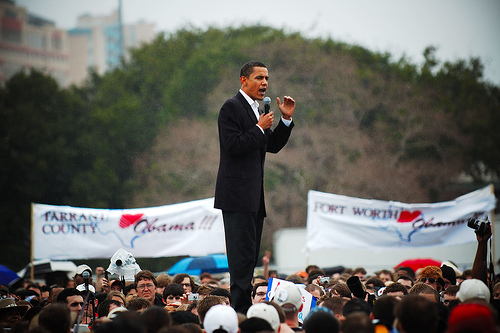
Election day is less than a year away. Time to settle in on a candidate.
I'm going with Obama.
I love the Clintons. I think the world of the Clintons. I've had enough of the Clintons. The last thing we need is a rerun of the '90s, with 50.01% (or less) elections and the Republican's pretty hate machines spewing vitriol against the new President every day. Mrs. Clinton is a great individual, someone I respect a lot, but her and her husband's style of politics is played. It's not that different from politics as played by the Bushies. And there's the Bush-Clinton-Bush-Clinton angle. Not something I really care to see in the history books of 2083.
I like John Edwards. I supported him for the nomination in 2004. But, on deeper reflection, let's get real: He has no constituency in either the nation at large, among the political class in DC, or among the press. I'm afraid an Edwards presidency would be like Jimmy Carter's presidency: feel good for its moral superiority but almost completely ineffectual in terms of actual accomplishments.
I thought Bill Richardson might work out. The "no Senator has been elected since JFK" argument has something to it (although LBJ was a Senator prior to his serving as Vice President, and RFK, a Senator when he was assassinated, could likely have won the Presidency). But Richardson has provided, to this point, no compelling reason for his being President. He shares Edward's lack of constituency.
Dodd and Biden are both sharp, thoughtful, guys, but not Presidential.
Obama is something different. While he has some of the constituency problems that Edwards and Richardson have, at least he is building a constituency. The very nature of his candidacy is of being for something, and should he win the Presidency, he will have built a pool of good will and political capital on which to draw. (That could happen for Edwards, but the current approaches he's taking don't have that quality. To me at least.)
Obama brings the quality of actually listening to others, of encouraging the participation of those you thoughtfully disagree with (see Donnie McClurkin), of listening to those you thoughtfully disagree with. I'm sure some of my colleagues on the LGBT-side of the universe will have a difficult time accepting that you have to treat those who don't treat you like a human being like a human being, that you have to listen if you expect to be listened to, but everything in my heart tells me that Obama is right about this.
Not just a place at the table, but a table at which all are truly welcome, even those you disagree with.
So, I've made my choice, and I'm going to actively support Obama.
Of course, I'll gladgly support the Democratic Party nominee for President of the United States of America. Mrs. Clinton, John Edwards. Dennis Kucinich, should events transpire. But I believe that Obama is the best candidate, the candidate who can take all the shit that the Republicans will throw without having to throw it back, the candidate who can change the process and the tone, making it possible to achieve more of the content of the discussion.
If you fall back on the old, "a black guy can't get elected," then you need to identify in your mind five people who wouldn't vote for Obama because he's black and call them on it. Let them know your thinking that thinking that way is unacceptable and inappropriate. It's not politically incorrect: It's uncivilized. It's unAmerican. It's brain damaged. It's cutting off your nose to spite your face. It's guaranteeing that you won't consider some good fraction of the alternatives, when the best result is only as good as your best alternative. It's refusing to treat individuals like individuals, which, when it comes down to it, is all that each and every one of us is.
While we have to be confident in the individual for whom we cast our vote, we can't ignore the historical context with any of Richardson (Latino), Mrs. Clinton (XX person), or Obama (black but mixed, non-traditional cultural background). Given all we've been through regarding each of those populations, it seems to me most appropriate that we should address the not just non-white but basically black before non-male or non-Anglo. We all know there will be a woman President some day, a Latino President someday, but we still need convincing that someone who is black can be President.
This is the time to convince ourselves. This is the time to put so many bugaboos of the last 231, 220, 107 years behind us and get around to ignoring race. To make that happen, we have to pay attention to race. Deal with it.
Obama might be today's Abraham, today's Martin, today's John.
Hope is audacious.
Keep hope alive.
Keep hope alive.
Obama, 2008.
Now.
(Photo on Flickr by An Agent.)
Labels: 2008, obama, politics, presidential
16 September 2007
Fred
I hate to speak ill of any fellow Tennessean, but Fred Thompson looks like Death warmed over. I'm confident that's what America is yearning for: The skull that walks!
Labels: fred thompson, politics, presidential
