20 May 2009
From Whence We Came
Still reading Volume 1 of Abraham Lincoln: A Life by Michael Burlingame.
President Truman is reported to have said, "The only thing that's new is the history you don't know." And, of course, we only ever know a tiny fraction of what is or what's been, so there's always opportunity to learn more.
Something I've learned I didn't know much about is the history of the N-word. Growing up in the US South during desegregation, I heard plenty of it, from family and from friends. But by then public usage by public figures was frowned on, even as they might've been using it in private. Instead of "nigger," it was "colored" and "Negro."
It was not always so. I don't know when the public usage by public figures or usages in the press became unacceptable, but in reading Burlingame, I've learned that it certainly wasn't in the 1850s. What follows are examples, all from the source above.
This is where those of us now living in the USA have come, from 150 or so years ago. Slavery in the South and Negrophobia in the North. There are examples of just as ugly of usages from northern opponents of slavery, almost all of whom, like Lincoln, believed just as much in white superiority as did the slave-owning Southerners. White-ism is deeply entrenched in American culture: even if it retains a certain unholy vitality in the South to this day, it remains pervasive and unrepentant throughout the land.
Then comes the war, the Emancipation, the XIIIth, XIVth, and XVth amendments, Reconstruction, Jim Crow, de jure and de facto segregation, desegregation of the military by Truman's presidential order, Brown v. Board of Education, Little Rock, Selma, Birmingham, Rosa Parks, Ole Miss, Dr. King, Watts, the Civil Rights Act of 1964, the XXIVth amendment, forced busing, redrawn legislative and House districts, etc., and finally, today, a mixed-race black President.
And there are still those who every time "the blacks" comes out of their mouths, you can still hear "those niggers," as if they were Steven Douglas trying to get re-elected to the Senate in 1858.
President Truman is reported to have said, "The only thing that's new is the history you don't know." And, of course, we only ever know a tiny fraction of what is or what's been, so there's always opportunity to learn more.
Something I've learned I didn't know much about is the history of the N-word. Growing up in the US South during desegregation, I heard plenty of it, from family and from friends. But by then public usage by public figures was frowned on, even as they might've been using it in private. Instead of "nigger," it was "colored" and "Negro."
It was not always so. I don't know when the public usage by public figures or usages in the press became unacceptable, but in reading Burlingame, I've learned that it certainly wasn't in the 1850s. What follows are examples, all from the source above.
The Democratic press also denounced Frémont supporters as "nigger-worshippers." An account in the Joliet Signal of a Republican rally there on October 8 sarcastically observed that it "was a wonderful day for the niggers and nigger-worshippers of this county. Our city is literally filled with enthusiastic Fremonters." [pp. 432–433]And so it goes, as Patti Smith once sang, "nigger nigger nigger nigger nigger nigger nigger."
...in the New York Herald, which referred to Lincoln as Douglas's "nigger worshipping competitor" espousing the "most repulsive disunion nigger equality principles and doctrines." [pp. 471–472]
The Little Giant [Douglas] then went into graphic and extensive detail about the indignities of "nigger equality" and race-mixing—hordes of blacks invading the state, holding office, becoming judges, and—horror of horrors, marrying with whites. "We must preserve the purity of the race not only in our politics but in our domestic relations," he thundered. (The word "nigger" appears in the account published by the Indianapolis Indiana Star Sentinel, which supported Douglas, but not in the Chicago Times. This difference lends credence to the claim that Douglas regularly used the word "nigger" instead of "negro," though the Congressional Globe and his organ, the Chicago Times sanitized his language.) [p. 474]
Douglas may have said "nigger" instead of "Negro." The Quincy Whig sarcastically noted that the Little Giant's "elegant terms" included an accusation that Lincoln espoused "the doctrine that 'niggers were equal to white men.' " The Whig asked: "Isn't this beautiful language to come from a United States Senator?" A journalist who interviewed Robert R. Hitt, the shorthand journalist who covered the debates for the Chicago Press and Tribune, wrote that during the second debate, held at Freeport, Owen Lovejoy became "thoroughly aroused by Douglas' reference to 'the nigger'—Douglas said 'nigger' not 'negro' as the Times reported on that occasion." Throughout the debate, "Douglas said 'nigger,'" though his "organ printed it 'negro.'" At Hillsboro, Douglas gave a speech in which "he uttered scarcely a sentence which had not the word 'nigger' in it," according to the Chicago Press and Tribute. In the later Alton debate, a reporter had difficulty hearing the Little Giant, but could make out some "emphatic words" like "nigger equality" and the Declaration of Independence was not made for "niggers."[p. 489]
This is where those of us now living in the USA have come, from 150 or so years ago. Slavery in the South and Negrophobia in the North. There are examples of just as ugly of usages from northern opponents of slavery, almost all of whom, like Lincoln, believed just as much in white superiority as did the slave-owning Southerners. White-ism is deeply entrenched in American culture: even if it retains a certain unholy vitality in the South to this day, it remains pervasive and unrepentant throughout the land.
Then comes the war, the Emancipation, the XIIIth, XIVth, and XVth amendments, Reconstruction, Jim Crow, de jure and de facto segregation, desegregation of the military by Truman's presidential order, Brown v. Board of Education, Little Rock, Selma, Birmingham, Rosa Parks, Ole Miss, Dr. King, Watts, the Civil Rights Act of 1964, the XXIVth amendment, forced busing, redrawn legislative and House districts, etc., and finally, today, a mixed-race black President.
And there are still those who every time "the blacks" comes out of their mouths, you can still hear "those niggers," as if they were Steven Douglas trying to get re-elected to the Senate in 1858.
Labels: history, lincoln, n-word, nigger, race, relations, stephen douglas, usa


20 January 2008
Rosie the Riveter / LoC Flickr Action / MLK Weekend
The Library of Congress is using Flickr so that self-selecting individuals—people with Flickr accounts who are interested—can tag photos from the LoC's photo collection. Here's the idea, from the (who knew?) Library of Congress blog.
One of the first 3100 photos is the one below.

Suggest something familiar?
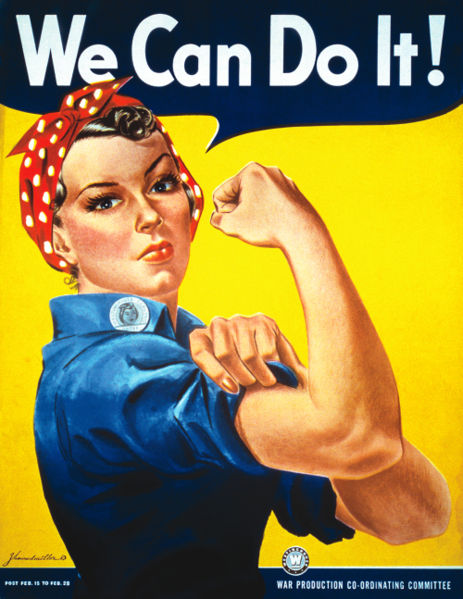
There were lots of Rosie the Riveters, but the WWII iconography makes it easier to think of them as all being white rather than the many skin colors of the people that make up the USA. So, for me, it's a nice photo to consider during this weekend when we celebrate the life of Dr. Martin Luther King. That Barack Obama and Hillary Clinton are duking it out for the Democratic nomination for US President only makes it that much more appropriate.
One of the first 3100 photos is the one below.
Suggest something familiar?
There were lots of Rosie the Riveters, but the WWII iconography makes it easier to think of them as all being white rather than the many skin colors of the people that make up the USA. So, for me, it's a nice photo to consider during this weekend when we celebrate the life of Dr. Martin Luther King. That Barack Obama and Hillary Clinton are duking it out for the Democratic nomination for US President only makes it that much more appropriate.
Labels: Flickr, library of congress, loc, mlk, race, riveter, rosie, usa
01 January 2008
01 January 1808 + 200 Years
200 years ago today, the import of slaves into the USA became prohibited. Eric Foner writes of that and the what ifs had the practice continued here in the New York Times. Link via the Volokh Conspiracy.
Labels: american, history, slavery, usa
18 February 2007
An Alternate Perspective on American Interests
Last night, I finished listening to the audio of this BloggingHeadsTV discussion between Michael Lind and James Pinkerton, both of the New American Foundation. I don't know squat about Pinkerton, but I've enjoyed several of Lind's books, including Up From Conservatism and The Next American Nation. He seems to me an honest American-centric intellectual whose sense of the nation extends well beyond his ivory tower. He has some interesting perspectives, some quite out of the mainstream, but they always seem grounded in well-researched history.
The discussion has to do with Lind's newest book, The American Way of Strategy. In it, he paints the current Iraq war in a strategic framework concerned more with keeping other great powers, Russia and China in this instance, out of the Middle East and securing American hegemony there. He doesn't dispute how things have gone wrong in the conduct of the war, but he frames it in something other than any of the removing a threatening state, removing a collaborator with terrorists, democratizing the Middle East, and War on Terror frameworks that have each been used at one or more times as the motivation for the war.
I haven't read the book, but intend to add it to the to-read list. In the meantime, the discussion at least has made me rethink some of my own ideas on the contemporary situation, particularly regarding the Islamacist threat. While Lind acknowledges that one nuclear bomb can ruin your whole day, he argues that the Islamacists, and Iran even, just don't pose a strategic threat to American interests, interests he sees, rightly in my perspective, as being more concerned with securing the survival of the Republic and it's democratic freedoms, and less with the interests of some imagined capitalist corporate or sectarian masters. He also argues, pretty persuasively, that maybe our interests are better served by a framework of great-power collusion and negotiation than either by going it alone or by trying to align almost 200 nations in one direction at the U.N.
An interesting listen/watch. If you've got an hour, you might want to consider it.
The discussion has to do with Lind's newest book, The American Way of Strategy. In it, he paints the current Iraq war in a strategic framework concerned more with keeping other great powers, Russia and China in this instance, out of the Middle East and securing American hegemony there. He doesn't dispute how things have gone wrong in the conduct of the war, but he frames it in something other than any of the removing a threatening state, removing a collaborator with terrorists, democratizing the Middle East, and War on Terror frameworks that have each been used at one or more times as the motivation for the war.
I haven't read the book, but intend to add it to the to-read list. In the meantime, the discussion at least has made me rethink some of my own ideas on the contemporary situation, particularly regarding the Islamacist threat. While Lind acknowledges that one nuclear bomb can ruin your whole day, he argues that the Islamacists, and Iran even, just don't pose a strategic threat to American interests, interests he sees, rightly in my perspective, as being more concerned with securing the survival of the Republic and it's democratic freedoms, and less with the interests of some imagined capitalist corporate or sectarian masters. He also argues, pretty persuasively, that maybe our interests are better served by a framework of great-power collusion and negotiation than either by going it alone or by trying to align almost 200 nations in one direction at the U.N.
An interesting listen/watch. If you've got an hour, you might want to consider it.
Labels: middle east, strategic interests, strategy, usa, war
